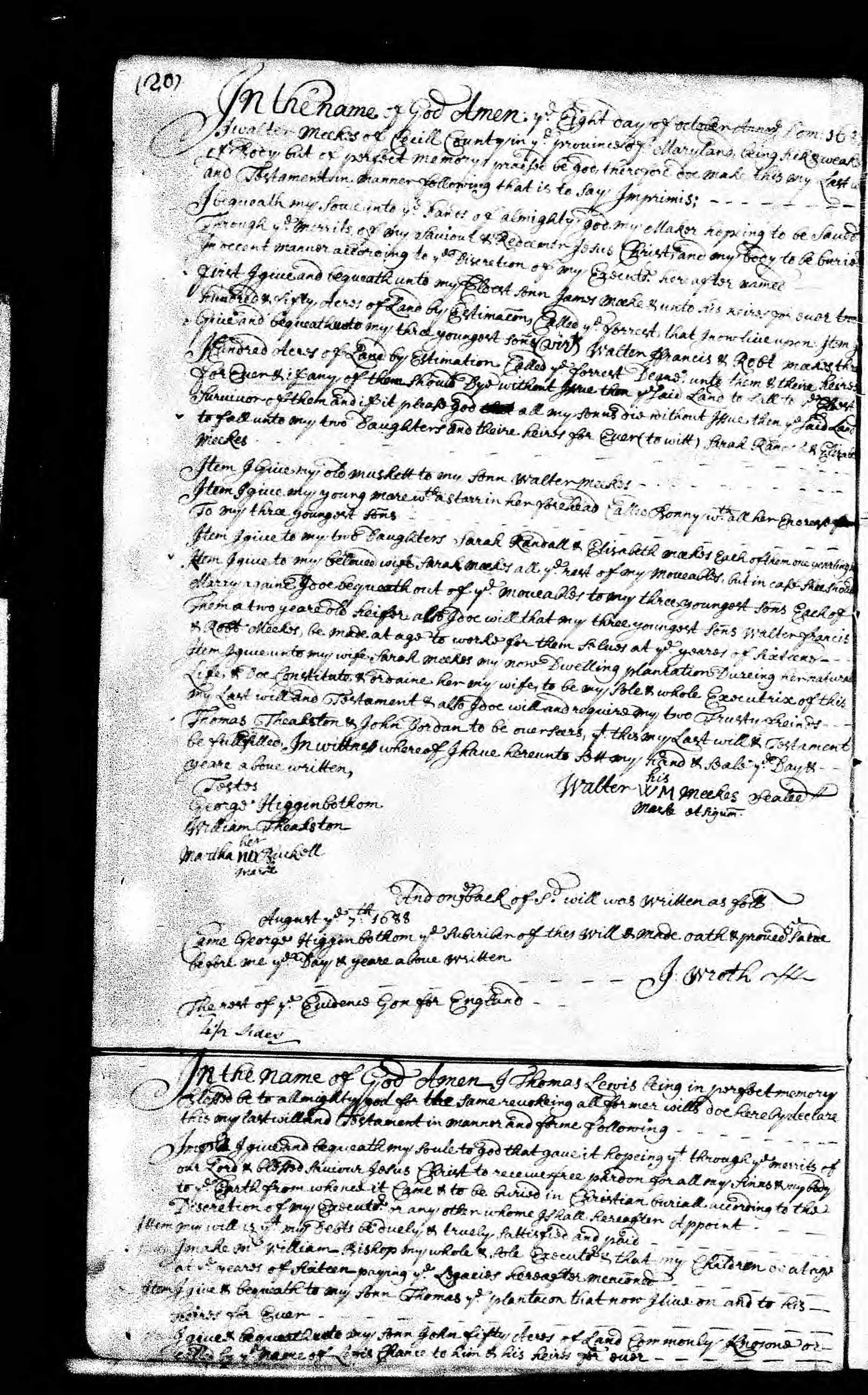
What it says
Walter Meekes, a Cecil County planter, names four sons and two daughters. Three of the sons were still minors in 1687, and their shares were left on conditions that assumed years yet to come. Only the eldest, James, was already independent; he received his 250-acre share outright. One of the daughters was already married as Sarah Randall.
An earlier land patent, of June 1675, describes "Walter Meeks of Baltimore County" bringing his wife Sarah, daughters Sarah and Elizabeth, and son James into the province — the same family the will describes twelve years later.
Why it matters
Nothing names Sarah Meeks's parents. This will is the basis of the leading hypothesis: that she was a daughter of Walter's eldest son, James. Of the four sons, only James was old enough to have had a daughter by about 1677. Two separate lines of reasoning point to him.
It is a hypothesis, not a fact. Sarah's 1707 marriage record points to Kent County, while everything about Walter's and James's family belongs to Cecil County. A separate Kent County Meeks family remains the simpler explanation.
One possibility is closed: Walter's daughter Sarah Randall cannot be Darby's wife. She was already married under another name by 1687 and would have had to be bearing children as late as 1728.
The original